AI Is a Brilliant Assistant — Just Not a Project Manager
By Nannapat J. · PMP®
Let me open with a confession that feels mildly dangerous to put in writing as someone who works in IT: I like the tools. I use them. I'm not here to wag a finger about the robots or write the four-hundredth think-piece about how everything is about to change forever.
But I've watched a lot of very smart people quietly assume AI is about to do my job — and I'd like to gently, lovingly push back. Because after actually using these things inside real projects, with real stakes and real people, I've landed somewhere fairly specific.
AI is extraordinary at the paperwork of project management. It's just not built for the job.
And the gap between those two things is, more or less, the entire role.
Let me show you where it falls down.
It writes a beautiful status report that's confidently wrong.
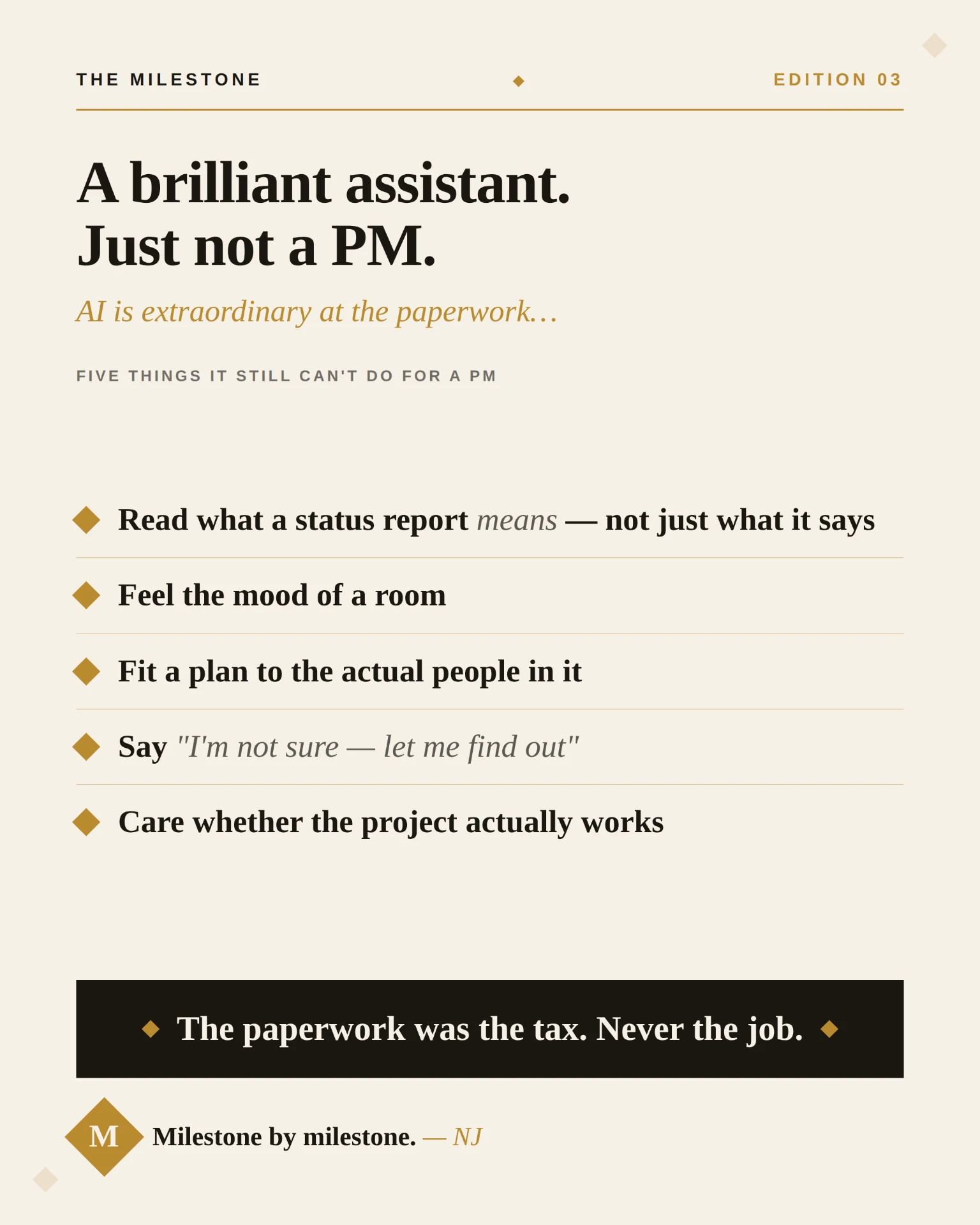
Ask a model to summarise a project update and it hands you something crisp, formatted, reassuring. The problem is it summarises what was said, not what's true. It doesn't know that "on track" has quietly meant "not quite started yet" three updates running. It can't smell the difference between a green status and a green status that's holding its breath. Reading that difference - and knowing which "fine" to trust - is not a formatting task. It's the job.
It can't read the room - mostly because it can't see the room.
The most important data in any project is almost never in the project. It's in the tone. It's the developer who stops volunteering updates. It's the stakeholder whose "yeah, that's fine" lands half a second too late. It's the meeting where everyone nods a little too easily. AI sees the transcript. It does not see the pause before the "sure." And the pause, friends, is where I earn my salary.
It optimises the plan and forgets the people.
Ask AI to re-sequence a slipping timeline and it'll do it in seconds - flawless logic, elegant dependencies, completely unusable. Because it doesn't know you can't move that date because the lead is on leave. Or that if you push the same team one more time, you'll spend goodwill you'll want back later. Or that this "tiny" change quietly re-opens a debate you only just got settled. A plan is easy. A plan people will actually follow is the hard part - and it runs entirely on things no model can see.
It is a confident intern who never, ever says "I don't know."
This is the one that genuinely worries me. A good PM's quiet superpower is knowing what they don't know - saying "let me check with the vendor" instead of guessing, because a wrong answer delivered confidently is more expensive than no answer at all. AI does the exact opposite. It answers. Always. Smoothly. Even when it is cheerfully inventing. It has the one habit it took me years to unlearn myself: total confidence, fully detached from whether it's actually right. Ask me how I know.
And it has no skin in the game.
When a project slips, I'm the one in the room explaining why. Accountability is the part of this job you can't hand off - not to a tool, not to anyone. A model will happily generate a recovery plan and then feel precisely nothing about whether it works, because it isn't the one who has to stand behind it in front of the steering committee. You can automate the artefact. You cannot automate being answerable for it.
So no - I'm not lying awake worrying about being replaced.
But here's what I am doing: handing the robot everything it's good at, as fast as I possibly can.
Because every minute AI buys me back from the admin is a minute I get to spend on the part of the job it can't touch. The corridor conversation. The "hey - is everything actually okay with this workstream?" The reading of a room. The slow, unglamorous building of trust that makes people tell me the truth before it becomes a problem instead of three weeks after.
And that's the quiet irony sitting underneath all the hype. The better these tools get at the paperwork, the more obvious it becomes that the paperwork was never the job. It was the tax on the job. Strip it away and what's left is stubbornly, almost reassuringly human: judgment, timing, trust, and the willingness to say "I'm not sure - let me find out."
A model can draft my milestone. It still can't tell me whether we've genuinely reached one.
I'd love to hear where you've landed on this - especially if you've found a spot where AI genuinely surprised you, in either direction. I'd love to read it in the comments.
Till the next milestone
Milestone by milestone. - NJ